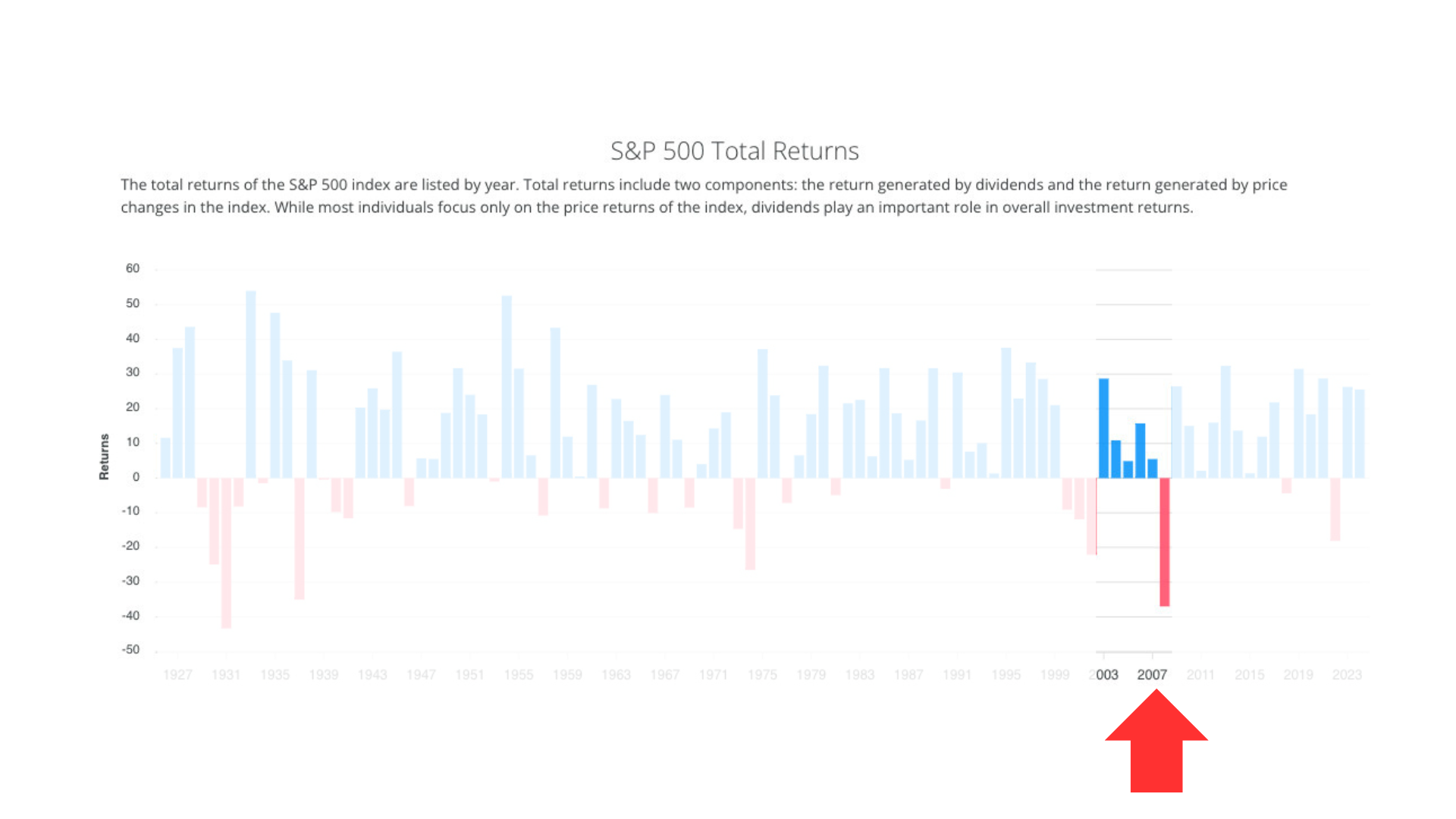
In last month’s article, Finding the Hidden Order in Financial Markets, I revealed one of the most fascinating discoveries of my 28-year financial services career. When viewing the U.S. stock market over the past century through the perspective of technical analysis, we can see a pattern of repeating and identifiable trends. These trends can be an investors’ friend or foe, but only if they are aware of them and choose to align their investment decisions with them. In this article I will share how people who embrace trend-based investment decisions can improve their odds of retirement pay raises compared to people who make age-based investment decisions. I’ll use “Daniel’s” story for illustration.
Several months ago, I was meeting with a long-time client who I will call Daniel. Daniel is 83 years old and needed to withdraw $27,077 from his IRA account for his annual Required Minimum Distribution (RMD). During our meeting we reviewed his six prior RMD’s and discovered when he was 77 years old in 2019, his RMD was $19,944. This was $7,133 less than 2025 which means Daniel has been enjoying pay raises from his IRA RMD as he ages.
Consider for a moment how this has manifested in terms of his account value and personal wealth. At the end of 2019 his IRA account balance was $429,942, compared to $522,776 at the end of 2025. Daniel’s wealth has increased by $92,834 over the past six years after accounting for all advisory fees, investment-related fees, and his RMD withdrawals (he has not made any contributions to his IRA account over this period).
The primary reason Daniel has found himself in this enviable situation is simple: he shunned conventional investment wisdom that suggests he make investment decisions based on his age. Daniel chose instead to follow a process that makes investment decisions based on what is always universal–the trend. For instance, an internet search for the suggested percentage of stock market exposure for an 80-year-old individual returns a suggested range between 20-40%. Once again, this suggestion is based on age. Daniel, in comparison, has maintained an average stock market exposure of 60-70% in his IRA account since 2019. The reason he has done so is based on the prevailing stock market trend.
There are at least three primary benefits Daniel (and anyone like him) could potentially enjoy when aligning investment decisions with the trend instead of age.
- For as long as the prevailing stock market trend is rising, he could continue receiving annual pay raises.
- Pay raises are symbolic of a higher account value, which can contribute to the likelihood of Daniel not outliving his money.
- Should his account value continue to increase, Daniel is afforded the opportunity to pass along a larger amount of money to his heirs.
Had Daniel followed age-based suggestions and maintained a much lower percentage of his IRA account in stocks, he may have maintained his IRA account value at best over these six years, or watched it decline at worse. Either way, the three potential benefits referenced above would not necessarily apply.
Having said all this, I would expect many people to provide a counter argument to the effect of how Daniel could have lost a lot of money had the trend declined over these past years or could stand to lose if it begins to decline soon. This is a relevant point. However, the answer to this potential conundrum can be summarized by Devin S. who left a review of my book and the backbone of the BLUE LINE INVESTINGÒ strategy.
‘Protecting the Pig’ separates itself from other books in the genre by providing us with the most valuable investment tool – an adaptive decision-making process.
Devin S.
(Amazon.com,
Devin S. is not a client nor was he compensated for his comments,
which may not be representative of any other person’s experience.)
Asset allocation decisions should not remain static over time, but should adapt as market trends change. How can we tell when the market trend may be changing? We defer to what history has taught us. Over the past century, every one of the five largest stock market losses came after the stock market fell below and remained below the Blue Line. Speaking of the Blue Line, where did the S&P 500 Index finish 2025 in relation to its Blue Line?
STOCK MARKET, WATCHING FOR THE TOP:

Chart courtesy of StockCharts.com, Data as of 12/31/25
The S&P finished the month of December 6.8% above the Blue Line, compared to 8.7% above the Blue Line at the end of November. If you are a reader who is not a current client and would like to learn how the BLUE LINE INVESTINGÒ strategy could benefit you, please send an email to info@bluelineinvesting.com with the word “Strategy” in the subject line.
Jeff Link
Portfolio Manager
Disclaimers:
The BLUE LINE INVESTING® (BLI) investment process was founded on over 95 years of stock market history. It seeks to identify and align investment decisions with multiyear trends. Various aspects of this process have been illustrated in my book Protecting The Pig: How Stock Market Trends Reveal the Way to Grow and Preserve Your Wealth.
The S&P 500 Index is one of the most commonly followed equity indices, and many consider it one of the best representations of the U.S. stock market, and a bellwether for the U.S. economy. It is comprised of 500 large companies having common stock listed on the NYSE or NASDAQ. The volatility (beta) of the account may be greater or less than the index. It is not possible to invest directly in this index.
Technical analysis is a method of evaluating securities by analyzing statistics generated by market activity, such as past prices and volumes. Technical analysis attempts to predict a future stock price or direction based on market trends. The assumption is that the market follows discernible patterns and if these patterns can be identified then a prediction can be made. The risk is that markets may not always follow patterns. There are certain limitations to technical analysis research, such as the calculation results being impacted by changes in security price during periods of market volatility. Technical analysis is one of many indicators that may be used to analyze market data for investing purposes and should not be considered a guaranteed prediction of market activity. The opinions expressed are those of BLI. The opinions referenced are as of the date of publication and are subject to change without notice. BLI reserves the right to modify its current investment strategies based on changing market dynamics or client needs.
Past performance is not indicative of future results. This material is not financial advice or an offer to sell any product. The information contained herein should not be considered a recommendation to purchase or sell any particular security. Forward-looking statements cannot be guaranteed.
Investment advisory services offered through Guardian Wealth Advisors, LLC D/B/A Blue Line Investing. Guardian Wealth Advisors, LLC (“GWA”) is an investment adviser registered with the U.S. Securities and Exchange Commission. Registration does not imply a certain level of skill or training. More information about GWA’s investment advisory services can be found in its Form CRS or Form ADV Part 2, which is available upon request.
GWA-26-02